From blank page to pitch deck
in five structured modules.
Each module produces something the student keeps. By the last session they are holding a validated idea, a business model, a working product and a deck — and they present it to a room. This is the whole sequence, module by module.
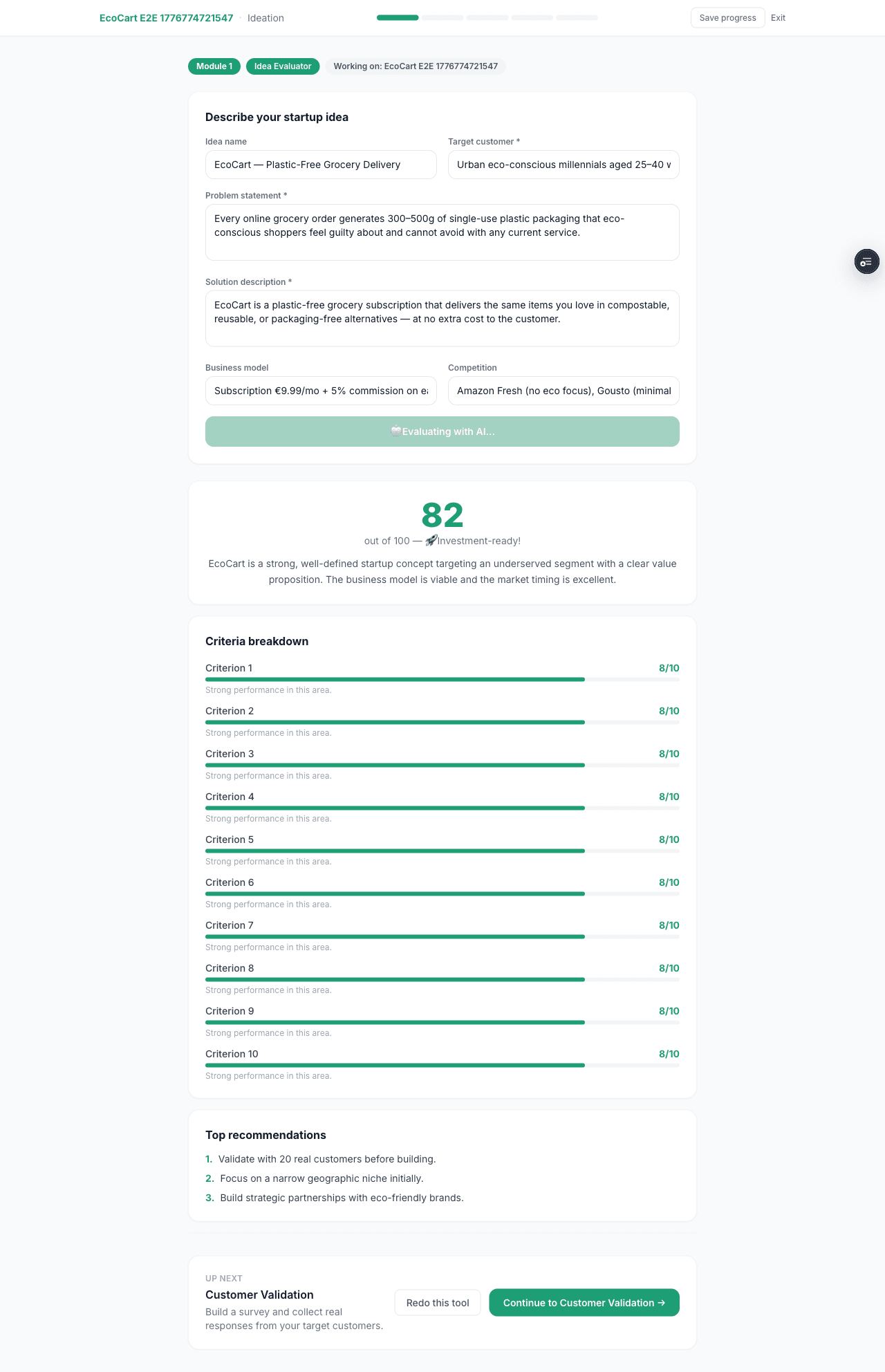
Module 1: Idea Evaluation
Student outcome
Your students define a real problem, identify a real user, craft a solution, and get an AI score with concrete recommendations.
School value
Builds critical thinking, problem-framing, and market awareness — core 21st-century skills.
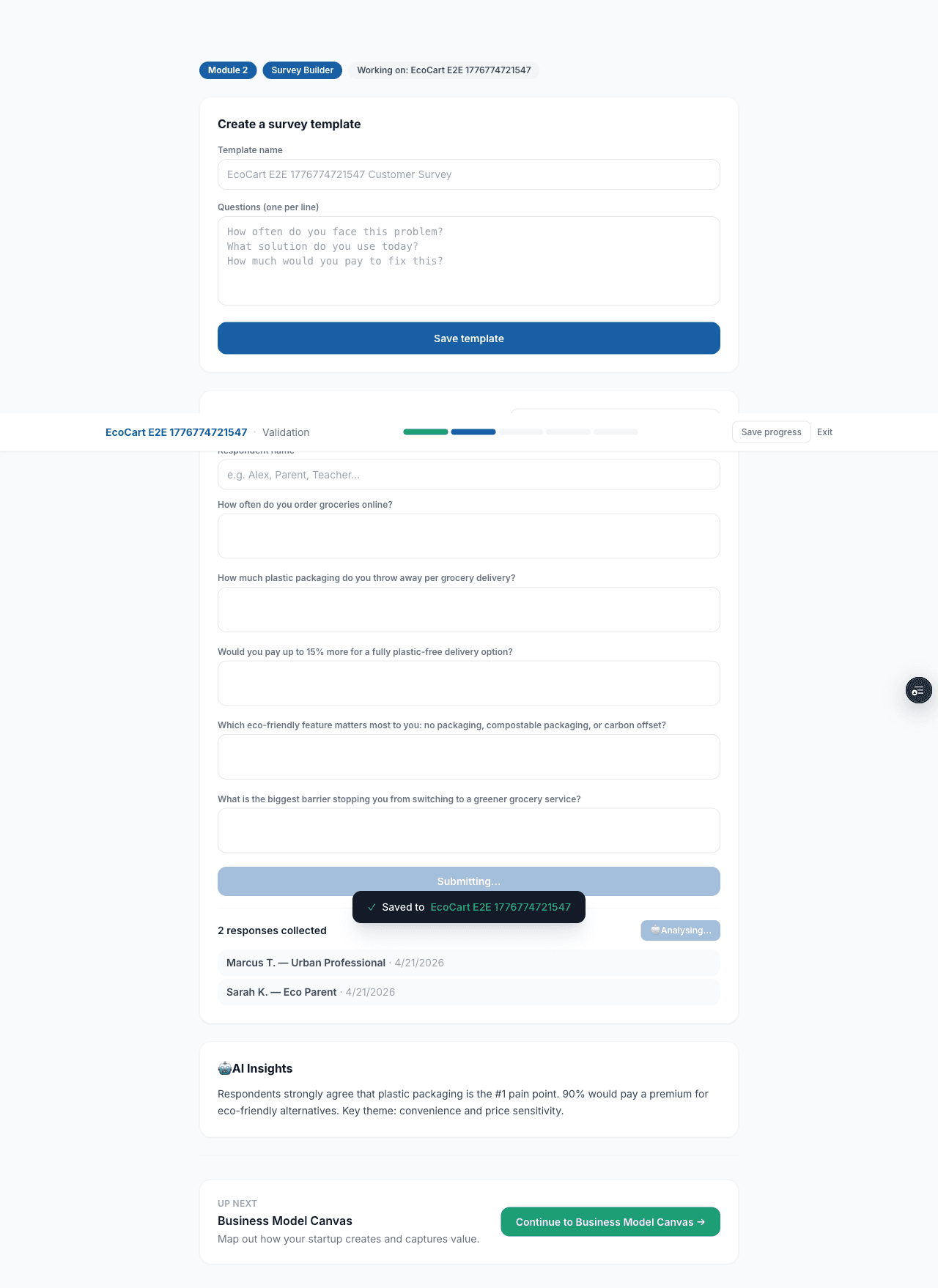
Module 2: Customer Validation
Student outcome
Your students design a survey, collect real responses, and pull out customer insights with AI-generated analysis.
School value
Builds research literacy, empathy mapping, and evidence-based decision making.
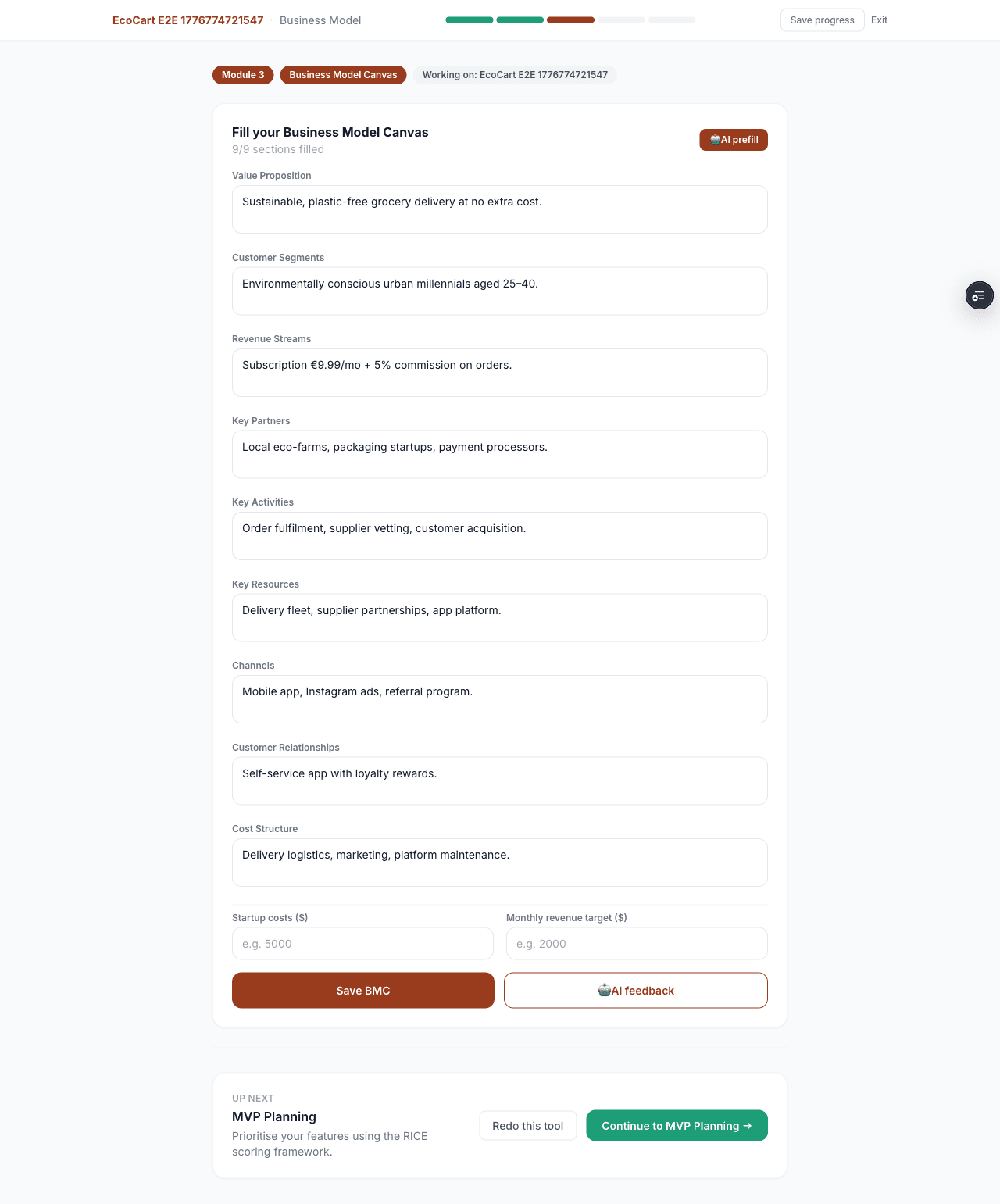
Module 3: Business Model Canvas
Student outcome
Your students complete a full Business Model Canvas with AI assistance — revenue logic, cost structure, value proposition.
School value
Introduces business fundamentals in a visual, accessible format that maps to IB project-based learning.
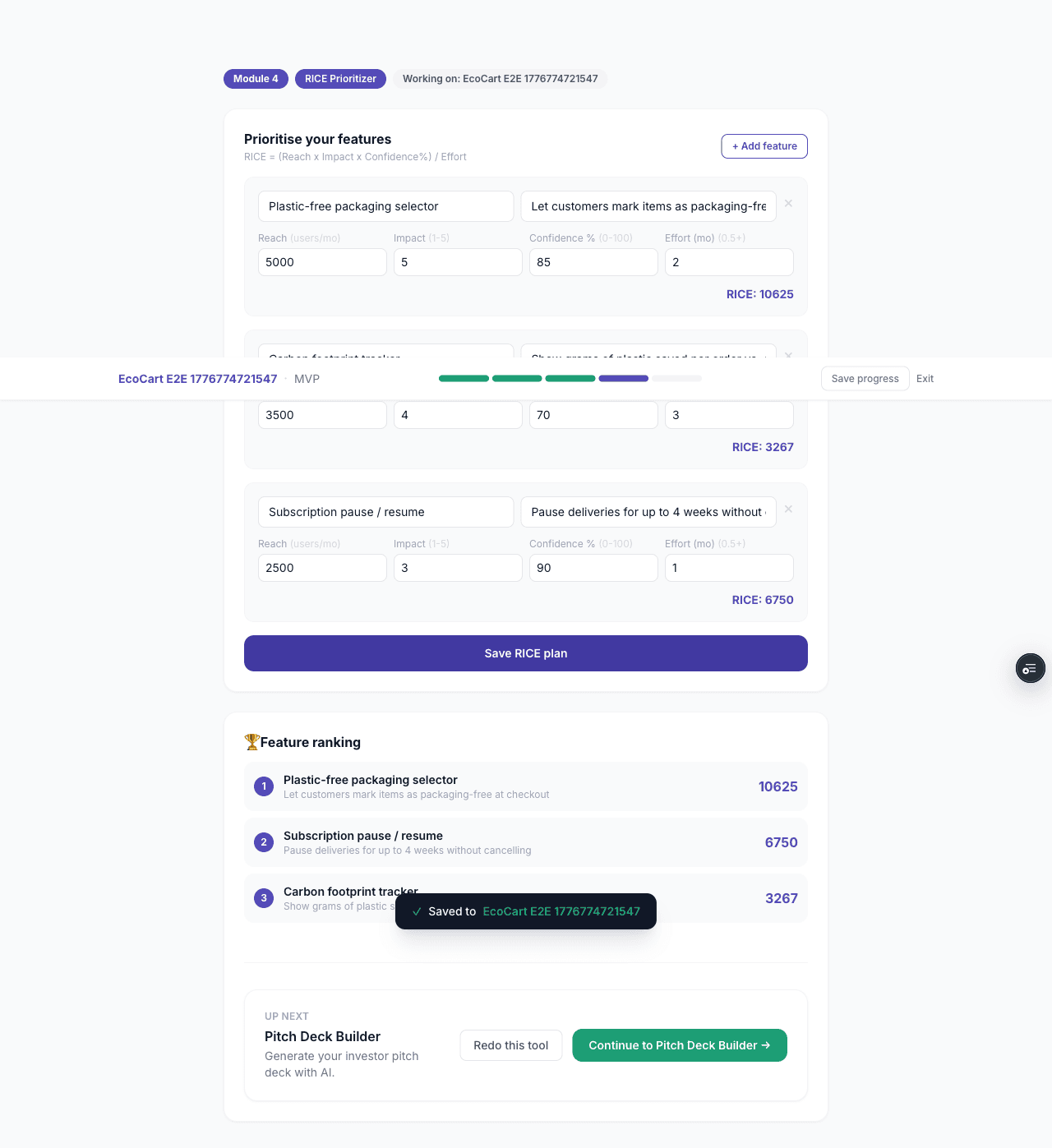
Module 4: MVP Planning
Student outcome
Your students prioritise features using the RICE framework and identify the smallest version of their product to ship first.
School value
Teaches product thinking, resource constraints, and engineering prioritisation.
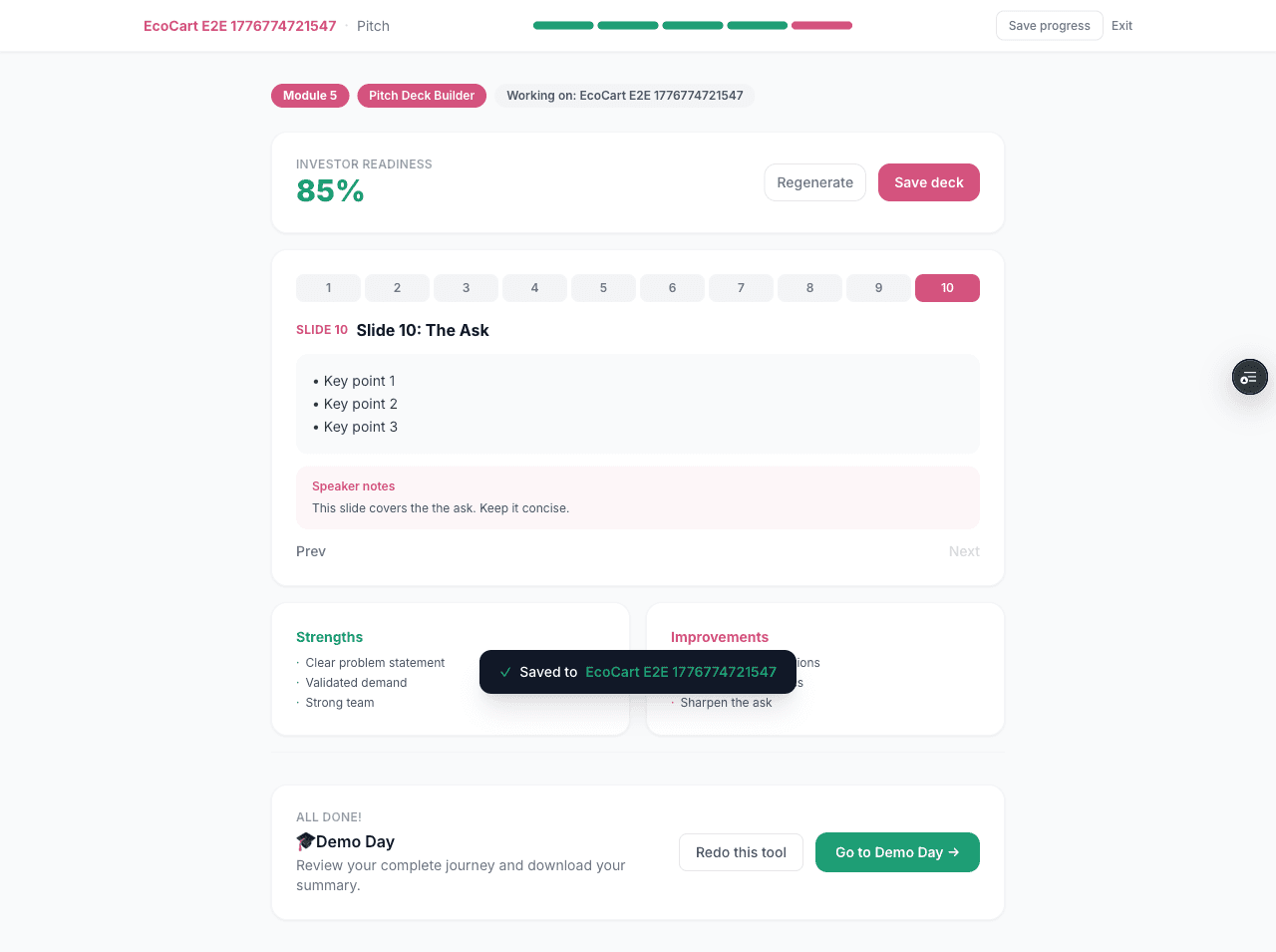
Module 5: Pitch Deck Builder
Student outcome
Your students generate a 10-slide investor pitch deck with AI guidance, investor-readiness scoring, and revision tips.
School value
Builds presentation skill, structured storytelling, and the confidence to step on a Demo Day stage.
What a student finishes with
Six artefacts, all of them theirs to keep and show.
A scored idea
A problem, a customer and a solution, scored against set criteria with written recommendations.
Real survey responses
Five to eight interviews with actual peers, and an analysis of what they said.
A Business Model Canvas
Nine blocks completed — revenue logic, cost structure, value proposition.
An MVP plan
Features ranked by RICE, cut down to the smallest version worth building.
A working product
Built with AI tools, deployed to a URL the student owns.
A pitch deck
Ten slides, scored for investor-readiness, rehearsed and presented on a Demo Day stage.
Frequently asked questions
How long does the curriculum take?
Six sessions across roughly six weeks, plus a Demo Day. Each session is self-contained and students do the work inside it, so nothing depends on homework being done between sessions.
Who teaches it?
A teacher or facilitator at your school. They do not need an entrepreneurship background — the structure carries the sequence and the AI gives each student feedback on their own work. At Arab International Academy the cohort was run by school staff, and every student finished.
Does it need to run as a timetabled class?
No. Schools have run it as an after-school club, an innovation elective and a term enrichment window. Six sessions is short enough to fit any of those.
What does a student need to bring?
A laptop and an idea about something that annoys them. No coding, no business background, no prior reading.
How does it map to IB?
The five modules line up with Personal Project, CAS and Design Thinking, and the research in Module 2 supports Extended Essay work. There is a detailed breakdown on the IB schools page.
Can it be delivered in Arabic?
Yes. The platform and the facilitation both run in English or Arabic.
Where to go next
- For schoolsHow a cohort runs inside a school, and how the modules map onto the IB framework.
- For students and parentsThe same six weeks described from a teenager’s side, with how to join one.
- The Demo DayWhat the sixth session builds towards, and what a school has to put on.
- How we measure itThe pre and post instrument behind the claim that the programme changes anything.
Run these five modules at your school.
Tell us your cohort size and when your term starts, and we will come back with a format and a quote.